Friday, June 4, 2010

SpaceX Successfully Launches Falcon 9 Into Orbit

SpaceX has just launched their first Falcon 9 rocket into orbit after having to scrub the first launch attempt, earlier in the day. The 55 meter (180 feet) tall Falcon 9 rocket reached orbit 10 minutes after lifting off at 2:45pm local time on June 4, 2010, in Cape Canaveral, Florida.


In December 2008, NASA announced that it has selected SpaceX's Falcon 9 launch vehicle and Dragon Spacecraft to resupply the International Space Station (ISS) when the Space Shuttle retires in 2010. The $1.6 billion contract will have a minimum of 12 flights, with the option to order additional missions for a total contract value of up to $3.1 billion. It will be less than half the cost of other competing systems of similar capabilities.


SpaceX's Falcon 9 rocket sitting on the launch pad.

Elon Musk, CEO of SpaceX, has been quoted as saying:
"100 percent success would be reaching orbit. Given that this is a test flight, whatever percentage of getting to orbit we achieve would still be considered a good day. If just the first stage functions correctly, it's a good day. It's a great day if both stages function."
It appears to be a perfect day, as SpaceX starts sifting through the flight data to help decide on any needed improvements. The Falcon 9 will fly three demonstration missions before it will be used to resupply the International Space Station.

Looking into the future, the company hopes to start sending people into space aboard their rockets and is currently developing a heavy lift launch vehicle capable lifting more mass into orbit than the Space Shuttle. Elon Musk even optimistically hopes to be involved in human missions to Mars by the early 2020's.

Friday, May 28, 2010

Beyond the Planets


Welcome back to What's Up?

Over the last two months we have explored the eight planets and even ventured through the asteroid belt. Moving beyond the planets, we come across dwarf-planet Pluto.

Pluto and its three moons; Charon,
Nix, and Hydra.
Pluto used to seem like a very peculiar object because it is tiny and so far from the sun, beyond chilly Neptune's orbit. When discovered in 1930 by Clyde Tombaugh it was supposed be Planet X.

Planet X had been made up to explain Uranus' strange orbit. Pluto just happened to be near where the hypothetical planet was supposed to be. It turns out the math was wrong and there wasn't a need for Planet X!

Pluto itself is remarkably small, even smaller than our moon, and is more like a giant comet in composition. This world hardly spans the width of the United States!

Pluto has three moons, one of which is almost half the diameter of the dwarf-planet! It is so big compared to Pluto, that the two orbit around each other, almost as if they were dancing. 

It even turns out that this "unique" object is actually one of hundreds or possibly thousands! Dwarf-planet Eris, another icy world, is even bigger than Pluto and there are many of these objects left to be discovered.

This region from Neptune's orbit and outwards is now known as the Kuiper belt. The Kuiper belt is similar to the asteroid belt, but almost all of the objects are icy worlds.


In 2015 we will get our first up-close look at Pluto and hopefully other icy worlds as NASA's New Horizon's space probe will zoom past Pluto and fly through the Kuiper belt.

Getting to Pluto and other Kuiper belt objects is nothing short of remarkable. Pluto lies fifty times further from the Sun than the Earth! This distance is greater than 7 billion kilometers (4.5 billion miles).

This may seem like a ridiculous distance but there are even more distant objects that orbit the Sun. Welcome to the Oort cloud. The Oort cloud is a spherical cloud of city-sized icy comets that orbit the Sun at a distance of up to one thousand times farther away than the Kuiper belt.

This distance so immense that it takes light a full year to travel from the Sun to the outermost comets. Astronomers call this distance the "light-year," which is roughly 10 trillion kilometers (6 trillion miles).

There are potentially billions of comets at this distance and the scary part is if another star comes close enough, the gravitational nudge from the star can knock some of the comets out of their orbits and send them flying towards the inner solar system. Thankfully, the nearest star is four light years away and has little effect on the Oort cloud.

Although most of the comets don't come very close to the Sun, some do. Many, like Halley's Comet, are quite spectacular with very beautiful tails of gas and dust streaming off of them as they are heated up and partly vaporized by the Sun.

These beautiful and graceful objects also have a dark side. The effects from a large rogue comet slamming into the Earth would be the same as an asteroid hitting us.

Let's just hope that funding for Earth-based observatories hunting for these dangerous objects isn't cut. A little advance warning could allow us to intercept the comet and push it off-course so it wouldn't hit us.

The last really big impact was 65 million years ago. Comets and asteroids don't hit very often so there isn't too much to worry about.

There won't be any close-ups with a comet next month, so let's see what else is up in next month's sky.

The new moon will be on May 14 and will become full by May 27.

Brilliant Venus will be visible low in the western sky shortly after sunset throughout the month. It will be the brightest star-like object in the sky.

At the same time, Mars will be a dull orange-red colour, spending the month in the south-western area of the sky in the constellation Leo, the lion.

Saturn will be a dim yellow this month in the constellation Virgo the virgin (southern sky after sunset) just off to the left of Leo.

The monthly meeting of the Athena Community Astronomy Club will be on the last Sunday of the month, May 30. The meeting goes from 7pm to 9pm at the Wilmot Community Centre. Guests are always welcome.

Until next month, just look up!


Hey Kids...
Did you know that orbits of the planets and moons don't stay the same? Our moon is drifting away from the Earth by a little over an inch per year. There are even two of Saturn's moons that like to change things up. Every four years the inner moon catches up to the outer moon and they swap orbits! These moons, Janus and Epithemius, are very similar to a large asteroid or comet. Who knows what else is out there? The sky is the limit.

Saturday, April 10, 2010

Venturing Among the Giants of the Solar System

Welcome back to What's Up?

Last month we started a tour of the solar system with the inner planets Mercury, Venus, Earth, and Mars. Let's continue that tour with the solar system's outer planets.
Before we continue our tour, the asteroid belt, which lies between the inner and outer solar system, must be acknowledged.

The asteroid belt is essentially a large zone filled with millions upon millions of space rocks, called asteroids. This belt is an interesting place and will possibly be the site of a future "gold rush." In one small asteroid (a kilometre or two across) there could be tens of trillions of dollars worth of precious metals and iron.

Unlike in movies and video games, navigating through the asteroid belt is fairly easy. The belt is so large that the asteroids are spaced many kilometres apart and are easy to avoid.

Now that we've safely navigated the asteroid belt we encounter Jupiter, the king of the planets. This huge planet is eleven Earths wide and has a mass 320 times that of Earth (see size comparison in the below image).

Jupiter has cyclones in its atmosphere that are so energetic they make Earth's hurricanes seem like a gentle breeze. One of those cyclones has been raging across the planet for 400 years and is three times the size of the Earth!

Jupiter also has four large moons, each of which are larger than our moon. These moons are Io, Europa, Ganymede, and Callisto.

The largest of these is Ganymede, so large that it is even larger than the planet Mercury. It may contain an ocean under its thick icy crust.

Europa is another moon with an ocean under its icy crust. This moon will hopefully be visited by a submarine mission to explore its oceans in a few decades. Maybe a Europan fish or eel will swim by the camera. Even a simple microbe would be one of the biggest scientific discoveries ever.

The next planet outwards from the Sun is the planet Saturn (image at left). Saturn features a great set of rings which encircle the planet. These rings are made of tiny chunks of ice and rock.

One of Saturn's moons is larger than Mercury and even has an atmosphere ten times thicker than Earth's. Instead of water raining from the skies, it rains liquid methane at -180°C.

Before we have to put on a tuque, let's move on to the planet Uranus (image below Saturn).

This planet lives up to its gassy giant status with significant amounts of methane in its atmosphere. Although it is commonly made fun of because of its name, it is a very interesting pale blue world which needs to be explored up close.

Most of Uranus' moons are named after characters from Shakespeare's writings. One of the moons, Miranda, is extremely bizarre. Miranda appears to be a heap of jumbled and mismatched pieces.


Moving on to Neptune, the last planet in the solar system (Pluto is now considered a dwarf planet), there is hardly any sunlight. This frigid world is almost completely composed of gas like the other giant planets Jupiter, Saturn, and Uranus.

Neptune (at left) may be the coldest planet, but it has the fastest wind-speeds and even had a storm the size of the Earth when the Voyager spacecraft flew by.

Neptune's largest moon, Triton, has cryogenic volcanoes. These volcanoes spew liquid water instead of lava.

Much is left to be learned about all of the planets, and in particular the outer solar system. Hopefully someday missions will be sent to learn about these interesting and exotic worlds.

Until then, let's see what's up in the sky this month.

The new Moon will be on April 14, while the full Moon will be on April 28.

Early in the month, shortly after sunset, Venus and Mercury will be next to each other low on the western horizon. Venus will be much brighter than Mercury.

Mars will be a bright orange-red high in the south while Saturn will be a mellow yellow in the south-east.

This month is Global Astronomy Month, an initiative to spread the wonders of the night sky. Astronomy Day will be on April 24 this month. Keep on the lookout for possible astronomy related events.

The monthly meeting of the Athena Community Astronomy Club will be on the last Sunday of the month, April 25, as usual. The meeting starts at 7pm and ends at 9pm. Guests are always welcome.

Until next month, just look up!

Hey Kids...
Astronomers recently discovered that the estimated number of galaxies in the universe is wrong. A galaxy is a blob of billions of stars. It turns out the estimated number of galaxies was ten times less than the actual number. They discovered the extra galaxies by tuning their cameras to look at a different colour of light that hadn't been looked at before. Our eyes have similar problems. We can only see visible light, which is a tiny fraction of all the colours of light. Infrared light can pass through clothing so maybe it's a good thing that we can only see visible light!

Thursday, April 1, 2010


A quick look at YouTube's new video watch page. Many changes have been made to the watch page to make it more simplistic and easier to use. The five star rating system being removed will likely be the most controversial change.

Saturday, March 27, 2010

Jupiter Through a Telescope and the "Burning Ship of the Northumberland Strait"

A video of the "burning ship" of the Northumberland Strait which is actually not a burning ship at all, but is the crescent Moon setting below the horizon. Jupiter is also shown as captured on camera that same evening. All videos and images taken through my 10" SkyWatcher dobsonian telescope.

Friday, March 12, 2010

What's Up? A Tour of the Inner Solar System

Welcome back to What's Up?

Over the next few years, NASA will be sending amazing new missions to the planets in the inner solar system. The four planets in the inner solar system are Mercury, Venus, Earth, and Mars (in that order from the sun). A little further out from Mars is the asteroid belt, a zone containing thousands upon thousands of asteroids.

Some of these missions to the inner solar system include the first mission to the planet Mercury, brand new Earth observation satellites, an enormous robotic Mars lander, and a mission that will visit the two largest asteroids in the solar system. There is also some funding for Earth observatories to keep an eye out for near earth asteroids that could impact the Earth.

There are going to be many interesting discoveries in the next few years, but let's take a tour of what we presently know about the inner solar system.


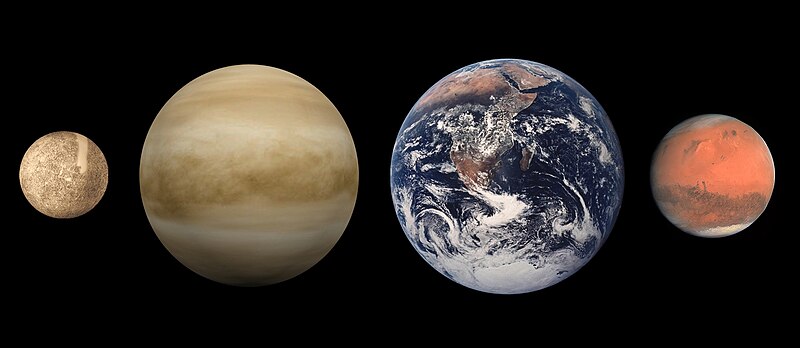
The planets of the inner solar system in order (distance not to scale): Mercury, Venus, Earth, and Mars.

The innermost planet and the smallest planet in the solar system (poor Pluto is now considered a dwarf planet) is the planet Mercury. It also has the most ancient surface of any of the planets as indicated by the many craters and lack of erosion. This surface may not have changed much in billions of years.

To go with its age Mercury even has wrinkles. These wrinkles were caused by Mercury contracting and cooling from when it first formed. The wrinkles were just found last year during one of the first flybys of Mercury by the Messenger probe, the first dedicated Mercury mission.

Since it is so close to the Sun, it has surface temperatures that can reach over 400°C but at night temperatures can drop to -180°C.

Mercury's year lasts only 88 Earth days while its "day" lasts about 59 Earth days.

The second planet from the Sun is Venus, which is also the hottest planet in our solar system. It is almost as big as the Earth and used to be thought of as Earth's twin and was thought to have oceans and life.

When probes were sent to Venus in the 1970's it was discovered that Venus was more of a hell than an Eden for life. The surface temperature is a scorching 460°C and has an atmosphere pressure 93 times greater than Earth's. That pressure is similar to diving one kilometre below the surface of an ocean. To top off this wonderful weather, it rains sulphuric acid!

One of the strangest things about Venus is the fact that it rotates in a direction different than the rest of the planets. This causes Venus' day to last longer than its year!

Venus is a very interesting world and is also the easiest planet to see from Earth. It appears as the second brightest object in the night sky, after our moon. It is so bright that people have mistaken it for an alien spacecraft of some sort.

The third rock from the Sun, the Earth, is the only planet known to contain life. Earth is also the largest rocky planet and the only world in the inner solar system with liquid on its surface.

Earth's moon is much larger than would be expected for a planet of Earth's size. The leading theory as to how the moon formed is that a Mars sized object impacted Earth four billion years ago and the ejected molten rock eventually came together to form the moon. For a few million years the Earth would have had rings just like Saturn!

Our planet's average temperature is 14°C but is on the increase because of global warming.

Moving on to the last of the inner planets is Mars, a small and chilly world that people may one day live on. Mars has ice caps made of frozen water and frozen carbon dioxide. The surface area of the red planet is roughly the same as Earth's land area.

Mars has had a very interesting and exciting past with huge floods that carved the biggest canyon in the solar system. Mars also has the tallest volcano, but it is no longer active. This monster volcano is 27 kilometres tall, or almost three times as tall as Mount Everest!

The average temperature on Mars is around -46°C, similar to a normal winter in Antarctica. When NASA is ready to send humans to Mars, they better bring a warm tuque!

While we're looking at the inner planets, let's see what's up in this month's skies.

The moon will be new on Mar. 15 and will swell to a full moon by Mar. 30.

An hour after sunset, Mars will be visible high in the southern sky. It will be a brilliant reddish-orange. Saturn will be rising in the East.

The first day of Spring is on Mar. 20 this year.

The monthly meeting of the Athena Community Astronomy Club is from 7pm to 9pm on the last Sunday of the month, Mar. 28.

Next month, we'll continue our tour of the solar system by taking a look at the outer solar system.

Until next month, just look up!

Hey Kids...
There is yet another space technology on the market: space underwear. Normally in the past, astronauts would wear clothes for a few days and since their is no laundromat in space, they would throw out the clothes. Japanese astronaut Koichi Wakata tried out some new space-age clothing material. He wore the same clothes for two months! The clothes eliminate odour, absorb water, dry quickly, are insulating, are anti-static, and are flame resistant. Space underwear is now on sale for $115 each.