Saturday, February 13, 2010

What's Up? Did Men Really Visit the Moon?


Welcome back to What's Up?

During the last few months, NASA's plan to get people back to the Moon has been under fire. It is said to be far behind and over budget. There are even rumours that the Obama administration is going to cancel the project altogether. Humankind returning to the Moon is well overdue, the last visit to the Moon was 38 years ago!

There is a growing number of people among the general public that believe NASA never sent astronauts to the Moon. This isn't some small fringe group anymore, there is actually a significant percentage of people who believe that the Moon landings were a big conspiracy.

A study in Russia found that 28% of Russians doubted that Americans had landed on the Moon and another study found 25% of Britons doubted the Moon landings. Even in the United States, about 25% of Americans between the ages of 18 and 25 are not sure the Moon landings actually happened.

There are also quite a few documentaries regarding the possibility of faked Moon landings, but do they actually have any good arguments?

One of the most common arguments against the Moon landings is how the American flag appears to be waving in the wind in photographs. Since there is no air on the Moon, how could the flag stay up and ripple in the wind?

If you carefully examine the pictures of the flag, you'll notice that a rod goes along the top of the flag to hold it up. The reason that the flag looks like it's waving isn't quite so obvious. When the astronauts were opening the flag up the rod didn't extend all of the way and the flag retained its rippled appearance from being folded up in storage. Although the flag shook for a few seconds it stood still afterwards it may still be standing there to this day.

The rippling flag that wasn't actually rippling in the wind! What else do the Moon hoaxers have for evidence against the Moon landings?

In the pictures it has been noted that there are no stars visible in the photographs. Can this be explained?

If you've ever tried to take a picture of something well-lit with a dark background you'll notice that you can't see the background at all. This happens because the camera adjusts its shutter speed so it won't take in too much light and make the well-lit object in the foreground too bright. Since the camera doesn't take in as much light, anything in the background that is too dim will not appear in the image.

Speaking of pictures, why are there no pictures of the lander, rovers, and instruments left on the Moon?

Well, actually, there are! Just last year NASA sent up a probe that is orbiting the Moon taking pictures of the Moon's surface in high detail. In some of these images the lunar lander module can clearly be seen and even trails of footprints can be seen!

The landing gear from the Moon landings was never been imaged before that because the Moon is on average, about 385,000 km (240,000 miles) away. Earth based telescopes can't see details on the Moon much smaller than a kilometer because of Earth's turbulent atmosphere, while the space-based Hubble telescope can't look at the Moon because it's too bright.

The final nail in the coffin for the case against the Moon hoax is the fact that special reflective mirrors were placed on the Moon by the astronauts. When a powerful laser is pointed at these mirrors, the light bounces back and can be detected with a large telescope. When the laser is pointed somewhere else on the Moon, no detectable light reflects back.

While our thoughts are still on the Moon, let's see what's up this month.

There will be a new Moon on Feb. 13 and will swell to a full Moon by Feb. 28.

Mars will be visible high in the south-east while Saturn will be rising in the east after sunset. Jupiter and Venus may be visible setting in the west shortly after the sun.

The Athena Community Astronomy Club's monthly meeting will be on Feb. 28, the last Sunday of the month.

Until next month, just look up!

Hey Kids...
Remember those Mars rovers Spirit and Opportunity? They were originally planned to drive for 90 days but have been going for over six years! Spirit has been having a lot of trouble lately. It recently got stuck in some deep sand and isn't able to get out. It can watch the weather and scientists can still learn some things from the stationary rover. The big issue is winter on Mars. The sun is getting low in the sky and it's going to get very cold. Spirit will spend the winter hibernating and will hopefully wake up in the spring. Keep your fingers crossed for Spirit!

Friday, February 12, 2010

The European Extremely Large Telescope (ESO)


This will, by far, be the largest optical telescope in the world. Capable of detecting Earth-sized planets around other stars, imaging Jupiter sized extrasolar planets, examining the early universe and so much more, this is the telescope of the future. Check out the video above and the link below for more information.

There's a great writeup on UniverseToday.com here: http://www.universetoday.com/2010/02/12/armazones-chile-to-be-the-site-for-the-42-meter-european-extremely-large-telescope/

Tuesday, February 9, 2010

Obama's New Plan for NASA - Video


With the release of NASA 2011 budget and within it the plans to cancel Constellation, Obama made some decisions to make NASA operate differently. The new plan will allow NASA to focus on space exploration while encouraging the commercialization of space.

Also, check out this interview of Phil Plait discussing NASA's new budget and why it needs to be pushed through Congress: http://www.earthsky.org/interviewpost/space/phil-plait-the-bad-astronomer-blogger-on-nasas-future

Saturday, February 6, 2010

Obama's new plan for NASA; Constellation cut

After much waiting and many rumours, it has finally been announced that in the 2011 budget Obama plans on cancelling the Constellation program. This program was designed to bring people back to the Moon but has been criticized for being way behind and lacking in innovation.

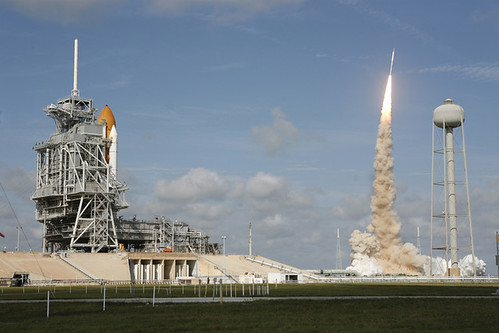
The first test-flight of the Ares I is seen in the above photo. The Space Shuttle is to the left. Credit: NASA

The new budget also contains many new ideas and approaches, many of which are supported by the Augustine commission, which Obama assigned to review NASA. This is a completely new path for NASA, one that has been needed since the end of the Apollo program, but has never been an option until now.

The budget outlines plans to use commercially available rockets to bring astronauts to the International Space Station and low earth orbit while NASA focuses on exploring beyond. In the budget, $6 billion dollars is to be invested over the next five years for commercial space flight. This extends the lifetime of the International Space Station to 2020, but will cost much less than it does currently.

There will be prize competitions just like the vertical take off and landing rocket competition in 2009. This will spur innovation and help new start-up companies as well.

These investments should create thousands of new high-tech jobs and should "spin off other new businesses that will seek to take advantage of new and affordable access to space.

Focussing on the Earth for a second (yes, the Earth is a planet too), NASA will be paying more attention to global climate change and its impact on our fragile world. To start, the Orbiting Carbon Observatory will be funded again. This satellite will shed new light on Earth's carbon cycle and monitor the changing amounts of carbon emissions world-wide.

Speaking of climate change, NASA will be focusing on "green aviation" and will work on technologies to "reduce fuel needs, noise, and emissions of aircraft."

Focussing on NASA's future in human space exploration are the following investments:

A $3 billion program over the next five years will feature robotic missions that will scout and explore new sites for humans to visit.

About $3 billion is going towards research and development of heavy lift rocket technology over the next five years. During that time there will also be $7.8 billion spent on new approaches to spaceflight, such as in-orbit fuel depots and propulsion systems for long distance space travel.

A few images of what future space propulsion technologies may look like. Credit: NASA

This is where NASA needs to be involved. NASA is the one that should focus on pushing boundaries and moving beyond current capabilities. The commercial sector will be a great way to shuttle astronauts up and down with just a little oversight from NASA.

SpaceX should be ready to launch astronauts within two, maybe three years. The cost per person? $20 million. That's half of what it costs to use the Russian rockets, and far, far less than the Space Shuttle. SpaceX expects to launch its first unmanned Falcon 9 this year.

Allowing commercial aerospace companies to run the shuttling of astronauts frees up NASA to explore. Exploration is the main purpose of the agency!

Of course, there are a few details to work out, but the overall idea sounds great.

As always, there is the opposition. The Constellation programs employs thousands and thousands of people; it's not going down without a fight.

When discussing Congress' silly ways of dealing with good NASA budgets, Phil Plait clearly states (and I agree):
"I’m pretty damn tired of that, and I’m going to do something about it. I’ll write my Congressmen, and I’ll tell them that the time for bending over backwards is long gone. It’s time to grow a spine, time for boldness, time for innovation. Whether people like it or not, this is the new budget being proposed, and if Congress wheedles over it, then yeah, NASA really will be screwed, and we’ll spend the next four decades circling our planet and gazing at the Moon, wondering when we’ll ever go back."
[Emphasis added]

In any case, if this gets pushed through it will (finally) start up the commercialization of space, bringing down cost and enabling something to get done rather than circling the Earth like a bunch of vultures waiting for NASA to die.

I desperately hope that this gets pushed through Congress. It's time for NASA to leave the front porch, hit the road, head to the Moon, nearby asteroids, and ultimately, Mars.

Sunday, January 3, 2010

What's Up? International Year of Astronomy 2009

Welcome back to What's Up?

As we enter 2010 we leave behind 2009, a very exciting year for many astronomy clubs and groups around the world.

2009 was the International Year of Astronomy, a year celebrating the 400th anniversary of Galileo's first recorded observations of the Moon and the sky with a telescope. It was declared by the United Nations and then the International Astronomical Union organized events worldwide.

The Athena Community Astronomy Club, the local astronomy club in Summerside, organized a few events through the year to get astronomy out to the public.

Throughout the summer, the club had evening sky viewings every clear Wednesday on the bay-walk. Throughout the roughly ten viewings we wowed passersby with views of the Moon, Jupiter, Saturn, and a few of the brighter nebula and star clusters through telescopes. A lucky few near the start of the Summer were able to spot faint little Mercury before it disappeared below the horizon.

On our second viewing, and many following viewings, many people just passing by were excited to look through a telescope for the first time. They were not disappointed. They could easily see Saturn's beautiful rings.

On August 6, the sixth public viewing of the summer, we saw the bright full Moon (almost too bright!) and got to look at Jupiter through a telescope. Through a telescope, three of Jupiter's four biggest moons discovered by Galileo 400 years ago were visible. 

There was also a new feature on Jupiter's disk. It had been hit by a large asteroid or comet a couple of days earlier and a faint black smudge was on Jupiter's relatively smooth orange disk. This dark smudge was about as big as the entire Earth! Jupiter is so large that the smudge disappeared within a few weeks and no trace remained.

On August 12 was the Perseid meteor shower. There was a good sized group out that night and we saw quite a few meteors (shooting stars). 

August 26 was a night to remember. We were having trouble with the clouds for well over an hour and we had finally gotten a break. On the horizon, looking out over the water, was what looked like a vivid red sail of a ship. It was the famous burning ship of the Northumberland strait!

We thought about it for a second and realized it was just the crescent Moon! We pointed our telescopes at it and yes, it was definitely the Moon. The Moon was so red because of all of the air it had to pass through, the blue light was scattered by the air and only the red light made it to us.

It is quite possible that every sighting of the burning ship over many years was just the crescent Moon setting. Who knew astronomy could be used to solve ghost stories?

Our club had a couple of monthly meetings at Scales Pond, hoping to get a viewing in, but the skies didn't cooperate.

One of our members took his telescope to Cabot park and showed Jupiter to a group of about 80 kids.

There was a past club member from Australia visiting along with her husband, who is the discoverer of two supernovae (so far). A supernova is a giant the explosion of massive star at the end of its life. The supernovae he discovered were in a galaxy so distant that the light from those stellar explosions took tens of millions of years to reach us!

To finish off the year, we had a guest speaker from the CSA, Richard Levéillé, who talked about Canada's role in space exploration. He spoke to a morning group of over 500 grade nine and high school students as well as to the public in the evening at the Harbourfront theatre.

Hopefully we'll be able to get out and see what's up some more in 2010, but for now, let's check out what's up in the coming month.

The Quadrantids meteor shower peaks sometime around Jan. 3 and can be a great show for a few hours but are very irregular. Keep an eye out for a few meteors if you're looking up at the sky that night.

The new Moon will be on Jan. 15 this month and will become full again by Jan. 30.

Mars' closest approach for the year will be on Jan. 29. This will be the best time to look at Mars through a telescope. 

After sunset, Jupiter will be visible low in the South-West while Mars will be rising in the East. Jupiter will be the brightest star-like object in the sky and Mars will be a fairly bright red.

The Athena Community Astronomy Club's monthly meeting will be on January 31, the last Sunday of the month.

Until next month, just look up!


Hey Kids...
Earth isn't the only object with a liquid on its surface. Saturn's biggest moon, Titan, has lakes, rivers, and some seas of methane (a key ingredient in animal flatulence). It's so cold there that the water never melts and the methane rains down, collects in lakes and eventually evaporates. Just last month, astronomers got the first direct visible light image through Titan's thick atmosphere. They managed to catch the Sun's reflection off one of the lakes. Maybe these lakes contain some kind of strange life. Nobody knows!

Saturday, December 5, 2009

What's Up? Telescope Giants of the Future

Welcome back to What's Up?

Last month, the new Herschel space telescope "fingerprinted" the largest known star, VY Canis Majoris. VY Canis Majoris is so huge that if it was placed in the solar system, the surface of the star would be beyond Saturn's orbit!

Spectral fingerprinting is what astronomers use to tell what something is made of. To do this, light is split up into its different colours, creating a rainbow. In the rainbow are thin dark gaps of certain colours. These gaps are very specific to certain atoms or molecules.

In the case of VY Canis Majoris, astronomers noted something startling. The different atoms and molecules detected coming from the star indicate that the star is ready to explode at any moment. This could be minutes from now, or thousands of years from now, nobody knows. 

This discovery comes only months after launching the Herschel telescope into space. It is an infrared (a type of light that you can feel as heat) telescope with a mirror width of 3.5 meters (11 feet) and is the largest telescope of its kind.

Many enormous new telescopes are currently being designed, but are very costly so only a few will be built. Some of these will be much larger than a tennis court! Why on Earth, would anyone want to make such a big telescope?

With your eyes, which are about half a centimetre in diameter (a quarter of an inch), you collect only a small amount of light particles (photons) when it's dark. With a large telescope you can collect a much larger number of photons. Think about it as the difference between collecting rain with a spoon and a bucket. The larger the light bucket - the telescope - the more photons you can collect and the fainter the objects you can see.

The largest optical telescope (observes light our eyes can see) is just over 10 meters in diameter (34 feet) and is situated on a mountain in the Canary Islands.

Even larger and more powerful telescopes are already in the works.

The Hubble space telescope has served astronomers well over the last two decades but is wearing out. Scheduled to "replace" the Hubble is the James Webb space telescope.

The James Webb space telescope is a massive infrared observatory. It is so big that its main mirror can't fit into the biggest rockets, so it will be cut into smaller pieces. Its mirror will be 6.5 meters in diameter (20 feet) and will be made of 18 segments that will unfold in space.

The James Webb will observe the formation of the first stars and galaxies billions of years ago, as well as being able to image large planets orbiting other stars.

The reason for sending telescopes into space is to get away from the atmosphere, which blurs and distorts the images.

A new technology to help Earth-based telescopes see clearly, called adaptive optics, changes the shape of the mirror thousands of times per second to correct for the Earth's annoying atmosphere.

At the moment, there are a few very large telescopes being designed, which could be many tens of meters in diameter. One of these is already in the final planning stages and is expected to be finished by 2018.

This telescope is creatively named the Extremely Large Telescope. Its mirror will span 42 meters (140 feet) and is expected to be 100 times as powerful as the Hubble telescope.

With this mirror it will be able to image the the closest extrasolar planets and resolve stars in many other galaxies. Using the spectral fingerprinting technique, it will be able to see how shifted to the red the colours in other galaxies are to tell us how fast those galaxies are moving away from us. It will even be able to see the redshift change over time as the expansion of the universe slowly accelerates!

There was another very large telescope planned, called the Overwhelmingly Large Telescope, but was scrapped because it was too expensive and too difficult to build. It would have been 100 meters (330 feet) in diameter and would have been able to regularly observe objects 1500 times dimmer than the faintest objects the Hubble telescope has seen.

It would even be able to get the spectral fingerprint of Earth-sized planets that could be around the 40 nearest sun-like stars! The spectral fingerprinting could be used to look for certain molecules that can only be created by life.

Maybe someday the Overwhelmingly Large Telescope will gaze upon the skies, but for now, let's see what's up this month.

On Dec. 2 the Moon was full and will become a New Moon again by Dec. 16. There is a second full moon this month, the "blue moon," on Dec. 31.

The Geminid meteor shower will be best later on the night of Dec. 13 or very early (about 3 a.m.) on Dec. 14. You can expect to see up to 60 multi-coloured meteors (shooting stars) per hour.

On Dec. 21 will be the Winter Solstice, the shortest day of the year (or the longest night if you want to look on the bright side). This is also considered the first day of winter, the season with the clearest and darkest skies.

The Athena Community Astronomy Club will be having its Christmas party on Sunday, Dec. 13 from 7pm to 9pm at the YMCA on Green's street.

Until next month, just look up!


Hey Kids...
Last month, new findings of the possibility of bacteria in a meteorite from Mars was published. The meteorite in question, is a large hunk of rock that was blasted off Mars during a big impact millions of years ago. In 1996 some scientists saw what looked like fossilized bacteria, almost like tiny fossilized worms. With new scientific instruments some interesting features were discovered. The material that the fossils are made out of is magnetite, a type of magnetic rock that is created by some kinds of bacteria. The way the magnetite was formed also looks like the way bacteria would leave it behind. Who knows, maybe it is the remains of life from Mars?

Sunday, November 29, 2009

Debunking 2012 Nonsense


In this video I debunk some 2012 doomsday theories: Mayan Calendar, galactic alignment, crossing the galactic plane, Eris, and Nibiru.